
Four Year Curriculum
A four-year journey that builds the interdisciplinary skills to analyze, adapt, and apply knowledge in real-world contexts—across disciplines, sectors, and global environments.
Your first year is structured around four Cornerstone courses that lay a foundation in the four core competencies that every Minerva student develops: thinking critically, thinking creatively, communicating effectively, and interacting effectively.
These courses introduce fundamental concepts, habits, and skills that are applied across disciplines and reinforced throughout your four years.
Cornerstone courses:

Formal Analyses
Focus on thinking critically through in-depth training in logic, statistics, and algorithmic thinking, using formal, computational, and quantitative approaches to formulate, analyze, and tackle problems.

Multimodal Communications
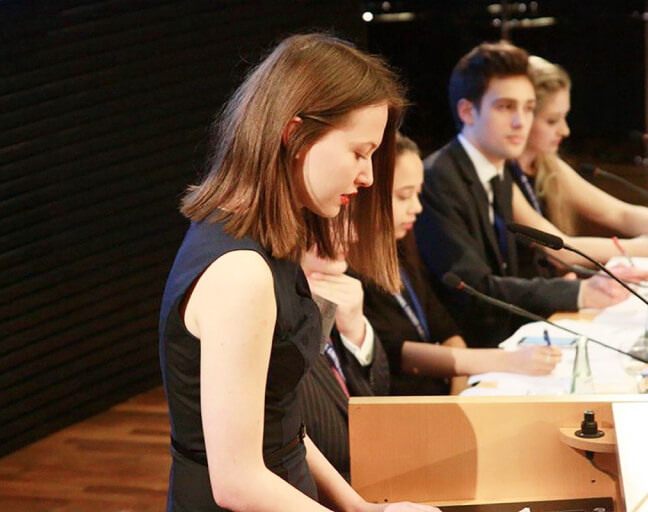
Learn to communicate effectively at a high-level and deeply analyze communications of various forms. You will form the skills and practical experience to write, speak publicly, communicate visually, design, debate, and express yourself artistically.

Empirical Analyses
Develop your creative thinking skills and familiarize yourself with methods used in social and natural sciences that teach you to effectively frame problems, identify solutions, develop and test hypotheses, design research studies, and reach plausible conclusions.

Complex Systems
Explore how humans function as members of various systems, using concepts such as multiple causality and multi-factor integrations. This course will develop your ability to interact effectively by participating in group project collaboration, negotiation, leadership, and formal debate.
Each year builds on the last, with coursework designed to deepen your understanding and expand how you apply what you learn.
Build core competencies.
Choose your path.
Deepen your expertise.
Bring it all together.
.jpg)
At Minerva University, you develop a unique set of transferable skills called Habits of Mind and Foundational Concepts (HCs) — practical ways of thinking and problem-solving designed to prepare you for a rapidly changing world.
Rather than focusing on memorization or a narrow specialization, Minerva’s curriculum helps you strengthen skills like critical thinking, communication, creativity, collaboration, and decision-making across every class and experience.
Your HCs help you continuously improve how you think, learn, and work with others, while the Foundational Concepts give you interdisciplinary frameworks you can apply across subjects, industries, and real-world challenges.
Together, the HCs help you build a lifelong cognitive advantage — preparing you to adapt, lead, and create meaningful impact in an increasingly complex global world.
Throughout the curriculum, students apply what they learn to real-world challenges in collaboration with organizations, institutions, and industry partners through civic projects.
Projects are integrated into coursework and grounded in the cities where students live and study. Working in teams, students engage directly with professionals, receive mentorship, and develop solutions that respond to real needs.
This work spans areas such as public policy, sustainability, technology, and global systems, and often results in tangible outputs such as research, policy recommendations, or product concepts.
Rebranding strategy for the Chinese-American Heritage Museum
An educational app for San Francisco pet owners about coyotes
An AI driven database advocating for free San Francisco public transit
A data journalism article examining the San Francisco housing crisis
Minerva offers majors that combine disciplinary depth with continued skill development.
Each major includes:

Core courses that build foundational knowledge in your field
.jpg)
Concentrations that allow you to specialize
.jpg)
Flexibility to explore interdisciplinary interests
Students may also design custom concentrations with faculty guidance.
Concepts introduced in one course are intentionally revisited and applied across disciplines, industries, and real-world environments throughout the curriculum and student experiences.
For example, students may learn analytical frameworks for evaluating and solving problems in their Empirical Analyses Cornerstone course through topics such as food insecurity or urban systems. In later coursework, students apply those same approaches to challenges involving:
.jpg)
Business and organizational decision-making
Artificial intelligence and emerging technologies
Public health systems
Climate and sustainability challenges
This approach ensures that learning is not confined to a single subject area, but becomes transferable across fields, industries, and evolving global contexts.
Your Capstone Project is the culmination of your four-year journey.
Beginning in your third year and completed in your fourth, it is a sustained, independent project that brings together your knowledge, skills, and interests.
You might:
.jpg)
Develop a business or social venture
.jpg)
Build a technological solution
.jpg)
Conduct original research

Create a piece of creative work
Recent projects have included work in healthcare innovation, sustainability, AI applications, entrepreneurship, and social impact.
One past Capstone project evolved into Eden Health, a startup helping expand access to medical imaging for millions of patients across Latin America.
Projects are presented during Manifest, a culminating experience that celebrates the completion of the undergraduate journey.
Every course is a live, discussion-based seminar where you actively participate.
You will:

Prepare before class using curated resources and exercises

Engage in structured discussion
.jpg)
Apply concepts in real time

Receive continuous feedback from faculty
This is a rigorous, highly interactive learning environment.
Minerva faculty are experts in the science of learning with a primary focus on guiding student growth and development.
Graduates leave Minerva with the ability to think critically and creatively, interact and communicate effectively, adapt to new environments, and apply knowledge across contexts.
Meet Our Alumni