
Undergraduate programs

A Degree That Moves With You: Four Years, Four Cities

A fully immersive undergraduate experience that develops the way you think, strengthens your ability to analyze complex challenges, and prepares you to apply your knowledge in real-world contexts. Live and learn in diverse cities around the world while developing the skills to lead globally.

What Your Education Actually
Looks Like

01

Learn in small, discussion-based virtual seminars built for active participation

02

Apply your learning through projects tied to each city’s systems and communities

03

Collaborate across cultures and disciplines to address complex challenges within real-world contexts

For example:

Analyze inflation and public policy in Buenos Aires with experts actively working on solutions.

Explore AI and technology systems in Tokyo in collaboration with local organizations and universities.

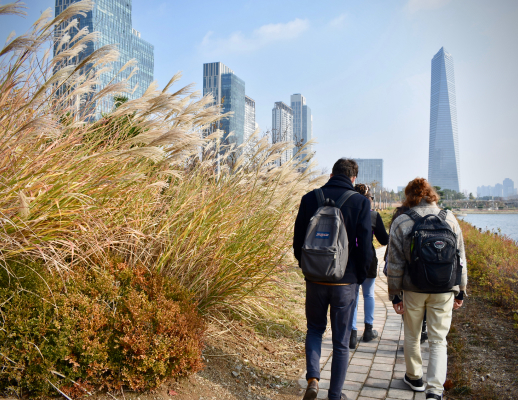
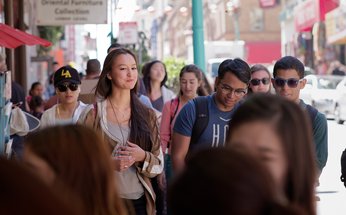
This isn’t study abroad. The city is your classroom.

See Student Experiences

Learning Through Real-World Projects

Each semester, students work in teams to tackle real challenges posed by local organizations, institutions, and industry partners. From public policy to sustainability to technology, these projects are embedded in the curriculum and grounded in the cities where students live and study.

Students collaborate directly with professionals, receive ongoing mentorship, and deliver tangible solutions—from product prototypes to policy proposals—that contribute to real-world work.

A Global Education, by Design

Your experience is structured to challenge you and build the skills to take on complex problems.

Year 1

Foundation (San Francisco)

Build how you think. Develop habits of mind and foundational concepts. Learn to analyze, communicate, and approach problems with rigor.

Year 2

Direction (Tokyo)

Apply your learning and problem solving in a new cultural and real-world context. Begin connecting ideas to action.

Years 3 & 4

Focus & Synthesis
(Buenos Aires & a European Experience)

Continue your journey across international cities, working across disciplines, engaging with real-world systems, and completing a capstone project that reflects your impact.

By intentionally aligning each global rotation with the curriculum, we ensure a seamless synergy between your physical location and your academic studies.

Locations are subject to change as Minerva continuously evaluates global conditions, safety, and program planning to provide the best possible student experience.

Learning How to Think

At Minerva University, you don't just learn information. You learn how to think.

Throughout your classes, projects, and global experiences, you'll continuously strengthen the transferable skills, mindsets, and competencies that prepare you to navigate complexity and create meaningful impact. These include critical thinking, communication, collaboration, creative problem-solving, and decision-making.

Rather than memorizing content for exams, you'll practice applying ideas across disciplines, cultures, and real-world challenges. This approach helps you become a more adaptable thinker, stronger communicator, and more effective leader.

Skills You’ll Build

Critical Thinking

Effective Communication

Collaboration

Creative Problem-Solving

Decision-Making

The result is an education designed to prepare you not just for your first job, but for a lifetime of learning, growth, and impact.

Your Education, Synthesized

In your final year, you'll complete a Senior Capstone Project, a deep, sustained piece of work that brings together everything you've learned across cities, disciplines, and real-world contexts.

Past capstone projects have addressed:

Climate resilience in coastal cities

AI policy and governance frameworks

Public health system design in emerging markets

Social entrepreneurship and impact ventures

How Cellular “Noise”  Shapes Gene Evolution by Leonardo I. Estrella Dzib | M26 | Mexico Leo modeled how random variation between cells affects gene networks over time, discovering that this biological "noise" actually pushes evolution toward more stable, reliable patterns of gene expression rather than disrupting it.
Modeling the World’s Trade Chokepoints by Finn-Frederik Hopmann | M26 | Germany Finn built a simulation of global shipping traffic, mapping the world's key trade routes and pressure points to show how closing a single chokepoint, like the Suez Canal, could disrupt supply chains across the globe.
A Guide to Greener Accounting for Food Retailers by Elizabeth Crewe | M26 | United Kingdom Elizabeth compared four leading sustainability accounting frameworks to build a decision-support guide, helping EU food retailers identify which framework best fits their regulatory pressures and financial goals.

No Passive Learning

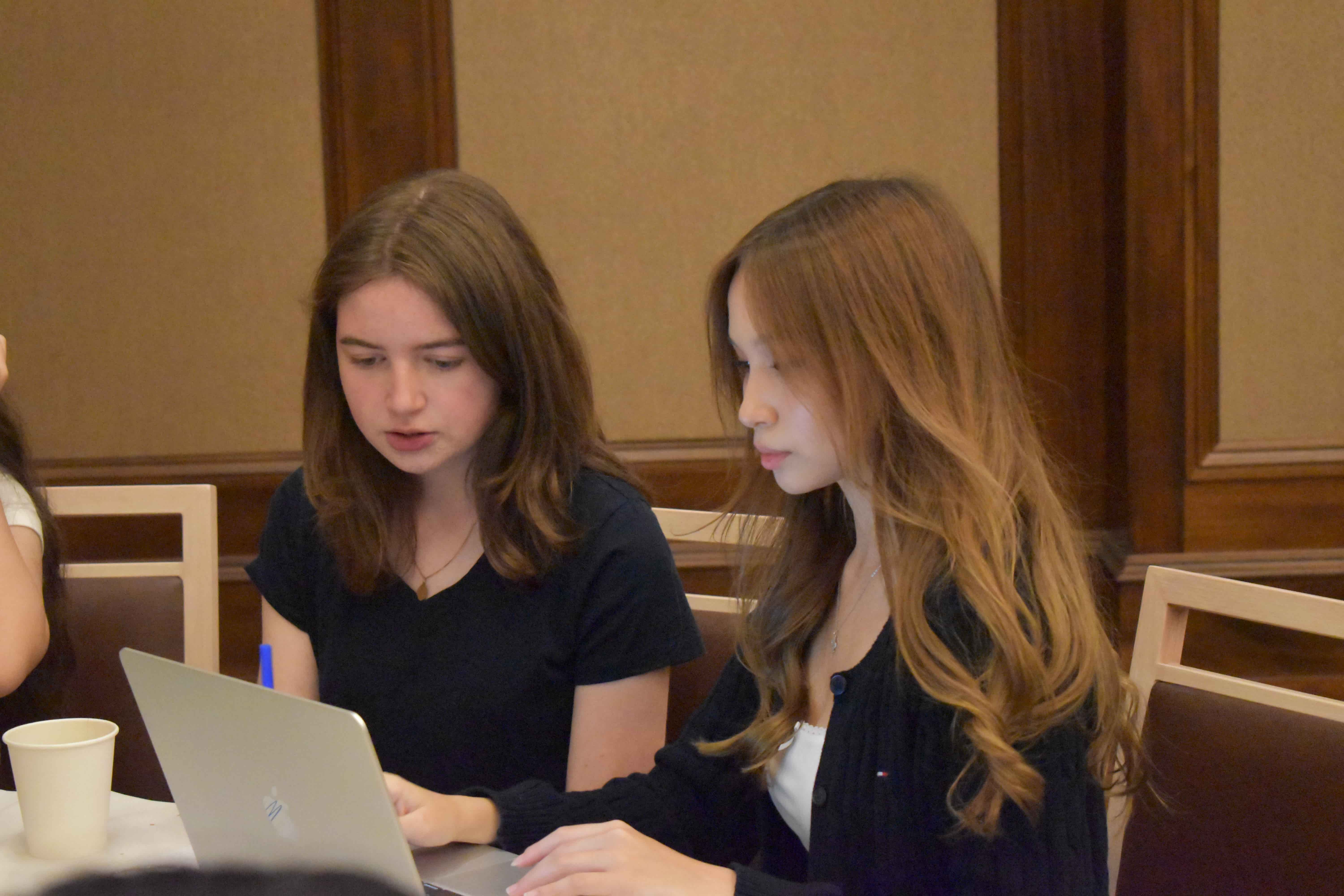
Every class is a live, virtual, discussion-based seminar of around 20 students. You’re expected to actively participate.

You’ll prepare for class beforehand and show up ready to debate ideas, analyze trade-offs, and apply concepts in real time. This is a rigorous environment designed for students who want to be challenged.

Students practice habits of mind and foundational concepts that help them to think critically, evaluate claims, make decisions, and solve complex problems across contexts.

Faculty Who Engage, Not Lecture

Minerva faculty are not lecturers. They are active scholars, practitioners, and industry experts who engage directly with students in small, discussion-based seminars. They challenge assumptions, guide inquiry, and help students apply ideas in real time.

Faculty also collaborate with students on research, creative work, and applied projects, extending learning beyond the classroom and into real-world contexts.

Meet Our Faculty

Interdisciplinary Majors

Minerva’s majors are designed to build essential skills and apply them across real-world contexts.

Business

Computational Sciences

Social Sciences

Arts & Humanities

Natural Sciences

Where This Leads

Outcomes that speak for themselves:

91%
of graduates are employed full-time or in graduate school within 6 months of graduation
Alumni have been admitted to Oxford, Stanford, Harvard, and other top graduate programs
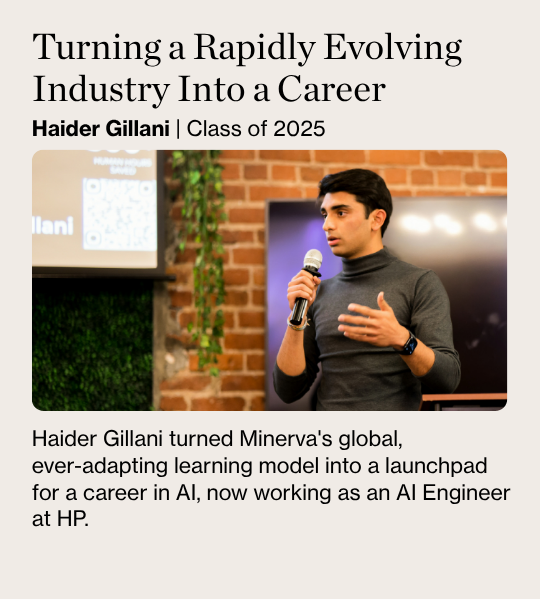
Graduates work at organizations including Google, BCG, the World Bank, and leading nonprofits
Minerva alumni have earned the Rhodes Scholarship, Schwarzman Scholarship, Knight-Hennessy Scholarship, and the Diana Award
30
Founding purpose-driven startups in more than 30 countries

Alumni Stories